

Gold pawnbroking in Malaysia is the most common way Malaysians turn jewellery, coins, or bars into short-term cash — but most people never realise there are two entirely different systems for doing it, and that not every “pawn shop” you’ll find is actually legal to use. This guide covers both.
What Is Gold Pawnbroking?
Gold pawnbroking is a loan secured against your gold instead of your credit history or income. You hand over your gold as collateral, receive cash immediately, and get it back once you repay within the agreed period. If you don’t redeem it, the pawnbroker keeps and sells the gold to recover the loan — nothing more is owed beyond that.
For the full step-by-step process of what happens at the counter, see our guide on how pawn shops work in Malaysia.
How Much of Your Gold’s Value Can You Borrow?
As a general guide, licensed pawnbrokers in Malaysia typically lend 70% to 90% of your gold’s assessed market value, depending on purity, weight, and the shop’s own valuation policy. The exact figure isn’t fixed — it moves with the daily gold price and varies between pawnbrokers.
For a full breakdown of how your specific valuation is calculated, see how much pawn shops pay for gold.
Conventional Pawnbroking vs Ar-Rahnu — What’s the Real Difference?
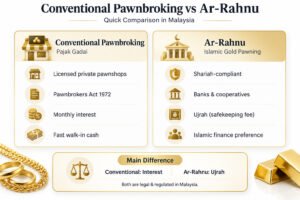
This is the question most first-time pawners actually have, and it’s rarely explained clearly. Malaysia has two parallel, both fully legal, systems for pawning gold.
How Conventional Pawnbroking (Pajak Gadai) Works
Conventional pawnbroking is run by licensed private pawnshops under the Pawnbrokers Act 1972. You pledge your gold, receive a loan, and pay monthly interest until you redeem or renew. It’s a straightforward commercial loan structure, available at pawn shops like AIENB across the Klang Valley.
How Ar-Rahnu (Islamic Gold Pawning) Works
Ar-Rahnu is the Shariah-compliant version of the same concept, typically offered by Islamic banks and cooperatives (such as Bank Rakyat, Agrobank, or Yayasan Pengurusan Zakat branches). The mechanics look similar — pledge gold, receive cash, redeem later — but the underlying contract and fee structure are built to comply with Islamic finance principles rather than charging interest.
Interest vs Ujrah (Safekeeping Fee) — What You Actually Pay
This is the core practical difference:
- Conventional pawnbroking charges interest, capped by law at up to 2% per month (24% APR maximum).
- Ar-Rahnu charges ujrah — a safekeeping/storage fee for holding your gold, rather than interest on a loan. The fee is typically calculated based on the gold’s value and the storage period, not as a percentage “loan cost” in the conventional sense.
In practice, both can end up costing a similar amount for a similar loan size and duration — the difference is the legal and religious structure behind the fee, not necessarily who’s “cheaper” in every case.
Which One Should You Choose?
Both are legitimate, regulated options. The right choice usually comes down to:
- Personal or religious preference — Ar-Rahnu is the natural choice for customers who specifically want a Shariah-compliant transaction.
- Convenience — whichever option has a branch near you, or offers hours that suit your schedule (AIENB’s drive-thru service, for example, is a conventional-pawnbroking convenience Ar-Rahnu providers don’t typically offer).
- Speed — private licensed pawnshops are often faster for walk-in, same-minute cash, since they’re built specifically around that service.
Is Gold Pawnbroking Regulated in Malaysia?
Yes. Conventional gold pawnbroking is governed by the Pawnbrokers Act 1972, which caps interest at up to 2% per month (24% APR), mandates secure storage, and sets out clear procedures for what happens if an item isn’t redeemed. Licensing and enforcement fall under the Ministry of Housing and Local Government (KPKT). Ar-Rahnu providers, meanwhile, are regulated as Islamic financial products, typically under Bank Negara Malaysia or the relevant cooperative/bank oversight body.
How to Spot a Licensed Pawnbroker — And Why It Matters
An unlicensed operator isn’t bound by the Act’s interest cap, storage requirements, or dispute procedures — which means far less protection if something goes wrong. Before pawning anything of value, check that the pawnbroker:

- Displays a valid pawnbroking license issued by KPKT
- Issues a clear, itemised pawn ticket for every transaction
- Charges interest within the legal cap (up to 2% per month)
- Stores your item in secure, insured conditions
- Can clearly explain the redemption period and renewal terms before you agree
Red flag: if a pawnbroker can’t produce a license on request, hesitates to issue a proper pawn ticket, or quotes an interest rate above the legal cap, walk away — you have no legal protection with an unlicensed operator.
Before You Pawn Your Gold: A Quick Prep Checklist
A little preparation makes the process faster and can improve your offer:
- Bring valid ID — IC, driver’s license, passport, or work permit; you must be at least 18.
- Know your gold’s purity — common purities are 999 (24K), 916 (22K), 835 (20K), and 750 (18K). Knowing which you have speeds up valuation.
- Separate your items by purity if you’re pawning multiple pieces, rather than mixing them together.
- Check the day’s gold price beforehand so you have a rough expectation before you’re quoted.
- Ask for a clear breakdown of the valuation — purity, weight, rate, and final amount — before agreeing to anything.
Gold Pawnbroking vs Other Short-Term Loan Options
| Gold Pawnbroking | Personal Loan | Credit Card Cash Advance | |
| Approval time | Minutes | Days to weeks | Instant, but high fees |
| Credit check | None | Required | Required |
| Collateral | Your gold | None (unsecured) | None |
| Risk if unpaid | Lose the gold | Debt collection, credit score impact | High interest, credit score impact |
| Best for | Short-term cash need | Larger, planned expenses | Emergency, small amounts |
Choose AIENB for Gold Pawnbroking
AIENB is a licensed conventional pawnbroker under the Pawnbrokers Act 1972, offering fair, market-based gold valuation and secure storage across the Klang Valley. We accept all common gold items — see our full guide on what you can pawn — with transparent rates and no hidden charges beyond a flat RM0.50 pawn ticket. Visit our Klang, Kota Damansara, Sentul, or Subang branch, or use our drive-thru service for a quicker visit.
FAQ
1. Is gold pawnbroking safe?
Yes, provided you use a licensed pawnbroker regulated under the Pawnbrokers Act 1972 — your gold is stored securely and insured for the loan period.
2. What’s the difference between gold pawnbroking and Ar-Rahnu?
Conventional pawnbroking charges interest capped at up to 2% per month (24% APR); Ar-Rahnu charges a Shariah-compliant safekeeping fee (ujrah) instead of interest. Both use gold as collateral.
3. How much of my gold’s value can I borrow?
Licensed pawnbrokers typically lend 70% to 90% of your gold’s assessed market value, depending on purity, weight, and the pawnbroker’s valuation policy.
4. How long can I pawn my gold for?
Typically up to 6 months, with the option to renew if you need more time.
5. Do I need good credit to pawn gold?
No — gold pawnbroking doesn’t involve a credit check. Your gold is the only thing being assessed.
6. What happens if I can’t repay my gold pawn loan?
The pawnbroker may sell the gold to recover the loan amount, as outlined in your pawn agreement — you won’t owe anything beyond that.